UGC NET December 2026 – Exam from 14 Dec, Admit Card 7 Dec
The National Testing Agency (NTA) will hold UGC NET December 2026 in computer-based mode on 14 to 18 December and 21 December 2026, in 87 subjects. NTA will announce exam cities on 23 November and release the admit card on 7 December 2026 at ugcnet.nta.nic.in. Registration has closed, and the one-time correction window ends on 4 November 2026 at 11:50 pm.
In this post
Key dates & links
- Online registration opened
- Application and fee deadline (extended, no late fee)
- Fee payment deadline for submitted forms (extended)
- Correction window opens
- Correction window closes
- Exam city intimation
- Admit card download
- Exam begins
- Exam, final day
Original notification
What UGC NET decides
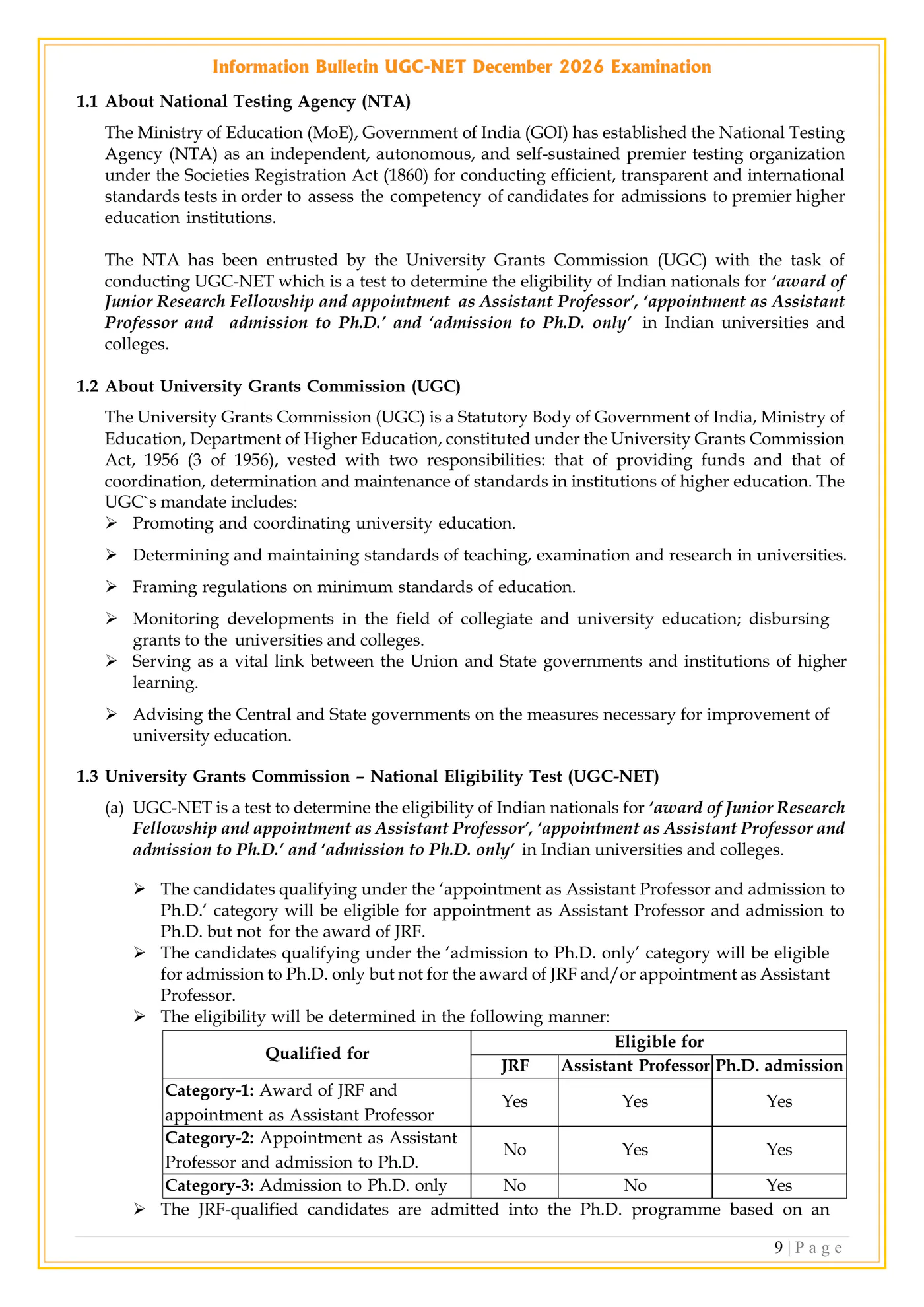
UGC NET decides eligibility for a Junior Research Fellowship (JRF), Assistant Professor posts and PhD admission. It is open to Indian nationals. The University Grants Commission (UGC) has asked the National Testing Agency (NTA) to run it.
Your result puts you in one of three categories:
| Category | JRF | Assistant Professor | PhD admission |
|---|---|---|---|
| 1. JRF and Assistant Professor | Yes | Yes | Yes |
| 2. Assistant Professor and PhD | No | Yes | Yes |
| 3. PhD only | No | No | Yes |
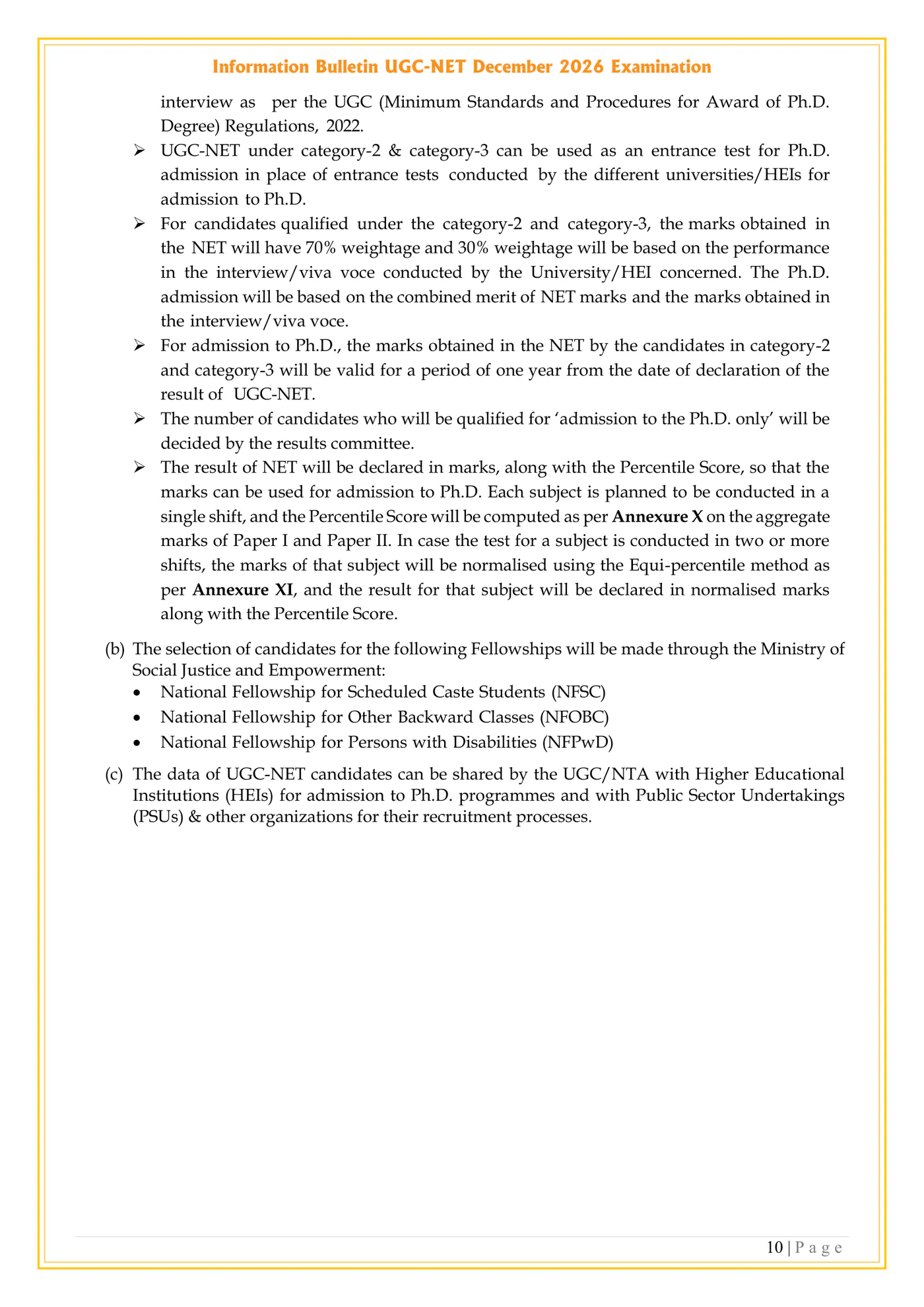
JRF holders join a PhD through an interview. For categories 2 and 3, universities give your NET marks 70% weight and their interview 30%. Those NET marks stay valid for PhD admission for one year from the result. A JRF offer stays valid for three years from the date of the award letter.
Key dates
| Event | Date |
|---|---|
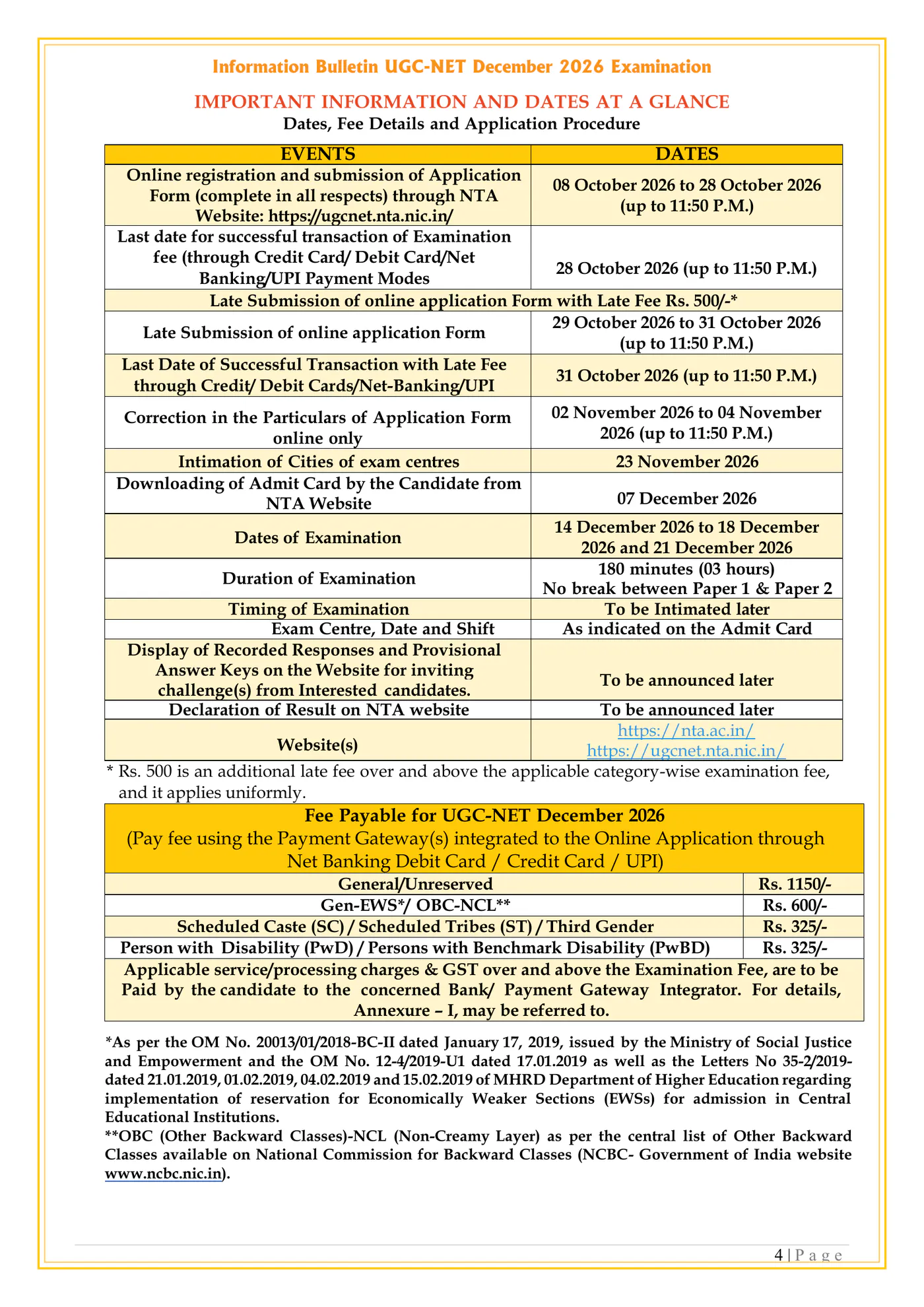
| Online application | 8 to 31 October 2026 (extended from 28 October) |
| Fee payment for submitted forms | Up to 1 November 2026, 11:50 pm |
| Correction window | 2 to 4 November 2026, 11:50 pm |
| Exam city intimation | 23 November 2026 |
| Admit card | 7 December 2026 |
| Exam | 14 to 18 December and 21 December 2026 |
| Shift timings | To be announced |
The opening notice of 8 October gave 14 to 19 December. The bulletin updated on 16 October lists 14 to 18 and 21 December. Go by the newer dates.
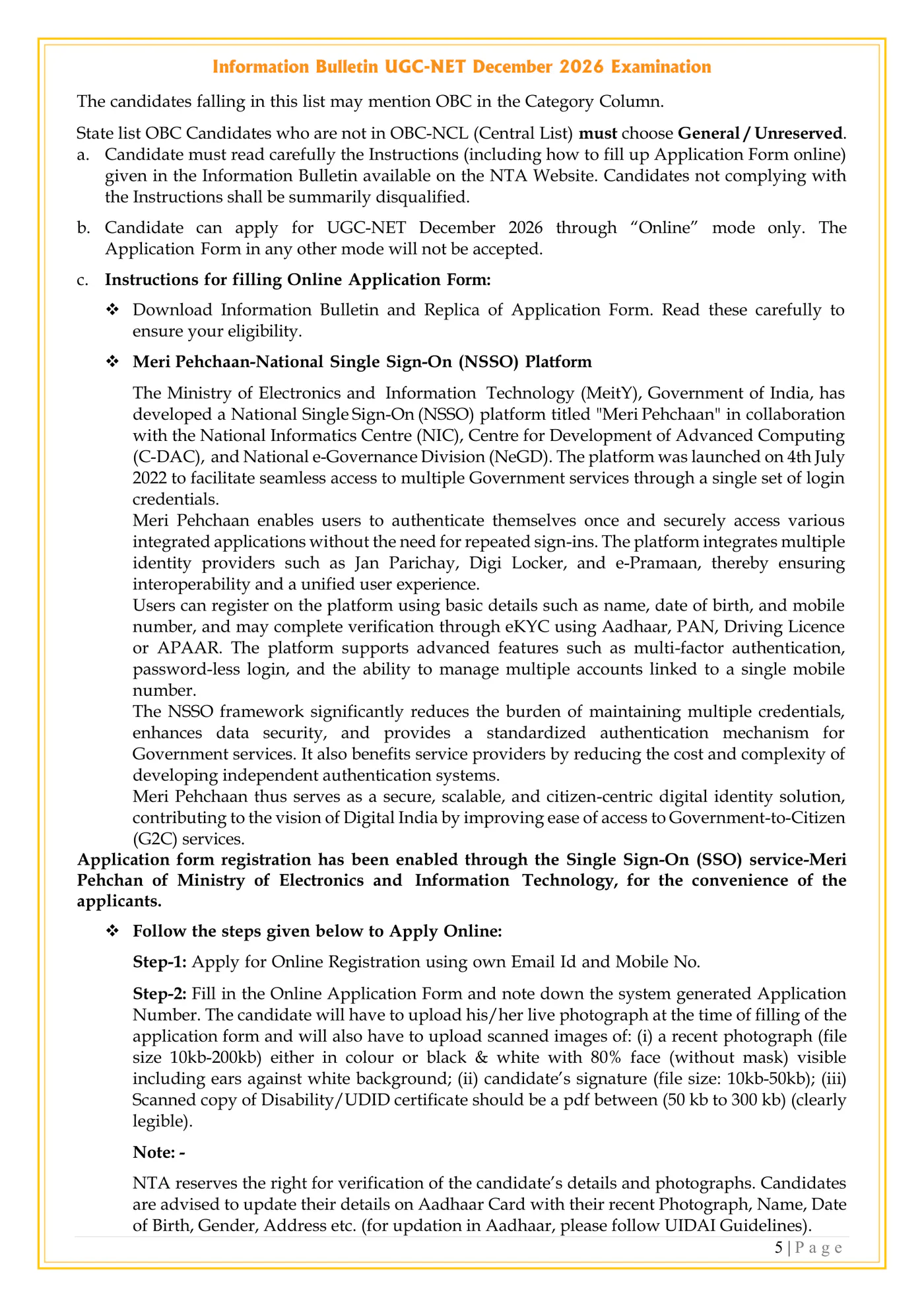
Registration is over. If you applied, check your form now. You get one chance to correct it, until 4 November at 11:50 pm.
You cannot change your mobile number, email, address, photo or signature. You may change one of your name, father’s name or mother’s name. Date of birth, gender, category, subject and exam cities are also open to change. So is the PwBD sub-category, if the UDID portal has not verified it.
You can submit corrections only once. After that, NTA freezes the form.
Eligibility
General and General-EWS candidates need at least 55% in a Master’s degree or equivalent from a UGC-recognised university. OBC-NCL, SC, ST, PwD/PwBD and third gender candidates need 50%. The bulletin says “without rounding off”, so 54.6% does not count as 55%. PhD holders who finished their Master’s by 19 September 1991 get a 5% relaxation, from 55% to 50%.
Final-year students and those awaiting results could also apply. They must pass the Master’s with the required marks within two years of the NET result. For PhD-only qualifiers, the limit is one year.
A four-year bachelor’s degree with 75% marks also makes you eligible. SC, ST, OBC-NCL, differently abled and EWS candidates may get 5% relaxation. On that degree, NET makes you eligible for JRF and PhD admission, not for Assistant Professor.
NTA does not check documents while you apply. If UGC or NTA finds you ineligible at any stage, it cancels your candidature.
JRF age limit and relaxation
| Purpose | Upper age limit |
|---|---|
| JRF | 30 years on 1 December 2026 |
| Assistant Professor | No upper age limit |
| PhD admission | No upper age limit |
The bulletin allows these relaxations for JRF:
- Up to 5 years for OBC-NCL (central list), SC, ST, PwD/PwBD, third gender and women.
- Research experience in your PG subject, up to 5 years, with a certificate from a recognised body. Research done for a degree does not count.
- 3 years for candidates with an LL.M.
- Up to 5 years for service in the armed forces, counted up to 1 December 2026.
Total relaxation cannot go above 5 years under any circumstances. The bulletin gives no worked example. Here is our own: a woman with an LL.M. qualifies on two grounds (5 and 3 years). Her relaxation still stays at 5 years, so her limit is 35 on 1 December 2026.
Fee
| Category | Fee |
|---|---|
| General / Unreserved | ₹1,150 |
| General-EWS / OBC-NCL | ₹600 |
| SC / ST / Third gender | ₹325 |
| PwD / PwBD | ₹325 |
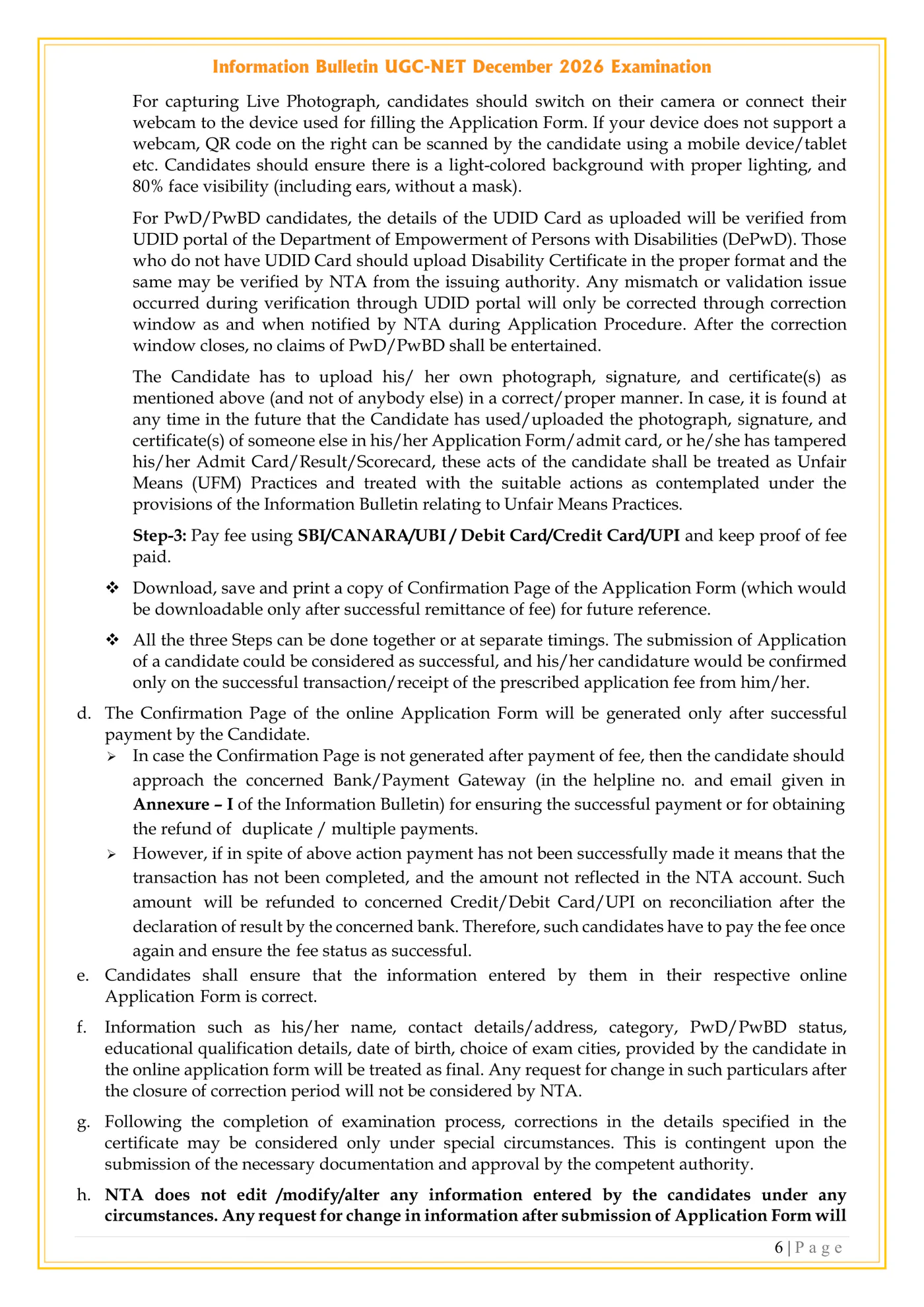
Bank charges and GST come on top. NTA’s 27 October notice extended the deadline to 31 October without any late fee. If a correction raises your fee, you must pay the difference. That correction takes effect only after the payment goes through. NTA refunds nothing already paid.
Exam pattern
The test runs in computer-based mode for 3 hours (180 minutes). Paper 1 and Paper 2 sit together as two sections, with no break and no separate time limit.
| Paper | Questions | Marks | What it tests |
|---|---|---|---|
| Paper 1 | 50 | 100 | Teaching and research aptitude, reasoning, reading comprehension, general awareness |
| Paper 2 | 100 | 200 | Your chosen subject |
| Total | 150 | 300 | 3 hours, all questions compulsory |
Each correct answer earns 2 marks. NTA does not cut marks for a wrong answer, so you lose nothing by attempting every question.
Only answers you save count; a question merely “Marked for Review” without a saved option earns nothing. The paper comes in English and Hindi, except language subjects. You answer in the medium you chose in your form. If the two versions differ, NTA goes by the English one.
Subjects
NTA offers 87 subjects, from Adult Education (code 46) to Statistics (code 107). The list also has Hindu Studies (102), Indian Knowledge System (103) and Disaster Management (104). Ayurveda Biology (105) and Forestry (106) appear too. Paper 1 is common to everyone.
The bulletin advises the subject of your post-graduation. If your PG subject is not on the list, pick a related one. Four-year degree holders may pick any subject they want to research for a PhD. Download the syllabus from UGC’s site, since NTA does not send it.
Qualifying criteria
You must appear in both papers. General and General-EWS candidates then need at least 40% aggregate across the two papers. Reserved candidates need at least 35%.
Clearing that line is only the first filter. NTA declares just 6% of the candidates as eligible for Assistant Professor. That 6% counts those who sat both papers on the basis of a Master’s degree.
NTA splits these slots by reservation and then by subject, which produces the cut-off for each subject and category. JRF slots go to categories the same way. There is no re-evaluation.
Each subject is planned for a single shift. If a subject runs in two or more shifts, NTA normalises its marks by the equi-percentile method. The 40% and 35% lines then apply to the normalised marks.
City slip and admit card steps
NTA’s bulletin gives the dates but not a click-by-click method. Steps 1 and 2 are our guide. The rest come from the bulletin.
- On 23 November, open ugcnet.nta.nic.in and look for the exam city link for December 2026.
- Log in with the details the page asks for, such as your application number.
- Note your city and start planning travel. NTA’s decision on city and centre is final.
- On 7 December, return to the same site and download the admit card. It shows your centre, date and shift.
- Print it clearly on A4 paper, with the self-declaration filled in.
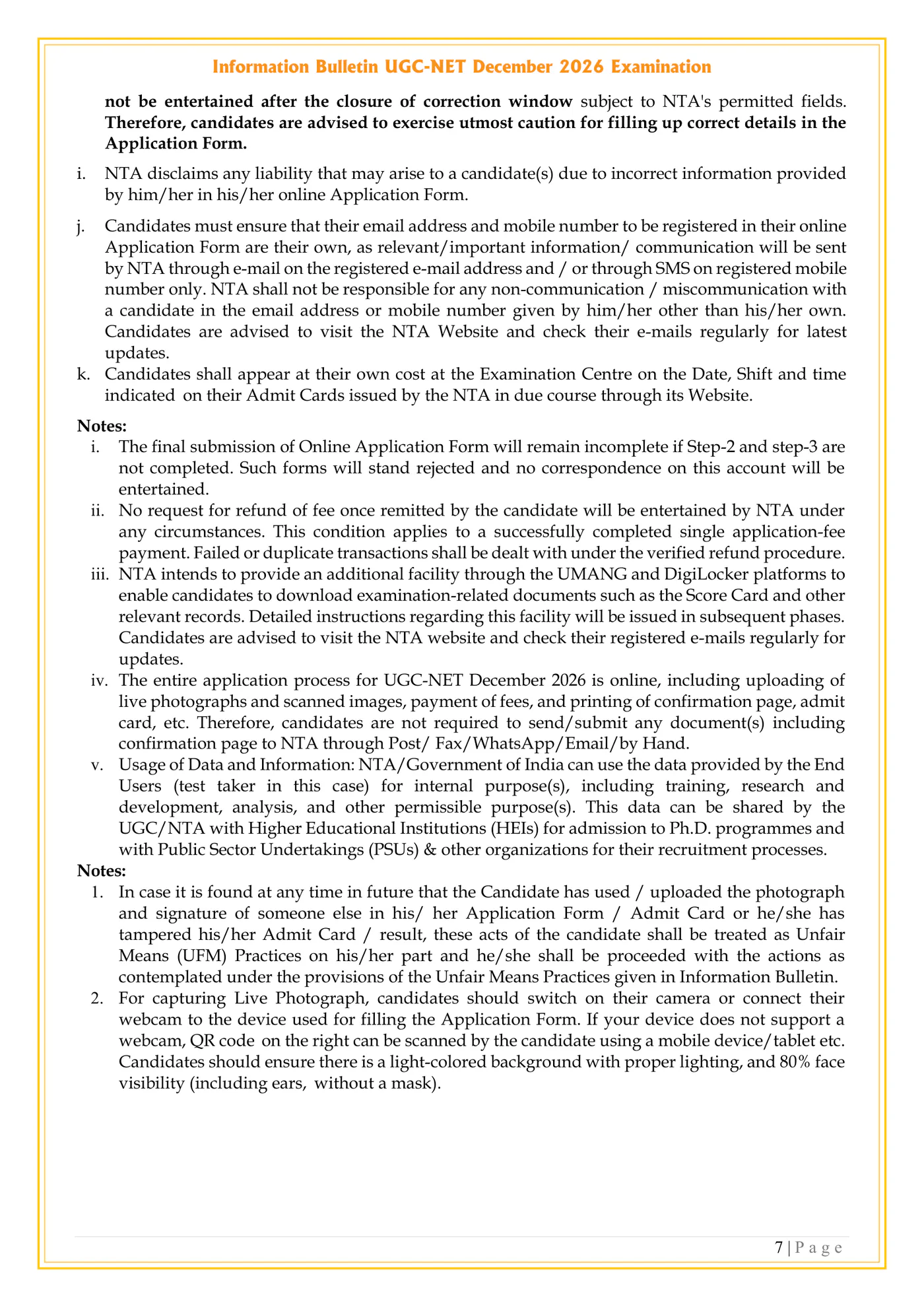
- Compare the photo, signature and details with your confirmation page. If anything differs, call 011-40759000 / 69227700 (10 am to 5 pm) or write to ugcnet@nta.ac.in. You still sit the exam with that admit card.
Far-off centres worried some candidates in the last cycle. In December 2025, Careers360 reported this post from a candidate on X:
“I got 3rd choice in UGC NET centre allotment that is 1000km from my current address. I am not able to travel.” (Careers360, 22 December 2025)
The same candidate wrote that all four choices had to be filled.
This cycle, the bulletin limits your four city choices to the state of your permanent or present address. If your state has fewer than four cities, you choose from those shown.
You may still revise them in the correction window until 4 November. NTA can still allot a different city, and it holds no re-test for anyone who misses the date.
Exam-day rules
Report 2 hours before the start. Gates close 30 minutes before the exam begins, and NTA will not let anyone in after that.
Carry these, or you will not sit the test:
- The printed admit card with the filled self-declaration.
- One passport-size photo, the same as the one you uploaded, for the attendance sheet.
- One original, valid photo ID: college ID, PAN, passport, Aadhaar or e-Aadhaar with photo, or a photo bank passbook.
- For a scribe or extra time (20 minutes an hour): your UDID card or the right disability certificate.
- Proof of a name change, such as a marriage certificate, if your name has changed.
Leave behind your phone, watch, wallet, belt, cap, goggles, jewellery, pens, papers and food. Diabetic candidates may bring sugar tablets and whole fruit. Water in a transparent bottle is fine.
Wear simple clothes. Heavy layers or large pockets may mean extra frisking. Shoes, slippers and low-heeled sandals are fine, but long boots are not. If you wear religious or customary dress, arrive at least two hours before the exam for frisking.
NTA gives you rough sheets in the hall. Write your name and application number on each one. (The CBT annexure says roll number, so follow the invigilator.) Hand them all back at the end.
For other teaching tests, see our CTET December 2026 guide and the latest teaching jobs and eligibility tests. School teacher posts in Bihar are in our BPSC TRE 4.0 vacancy guide. Hall tickets for other exams are in our admit card updates.
Frequently asked questions
When is the UGC NET December 2026 exam?
NTA will hold it on 14 to 18 December and 21 December 2026. Your own date and shift will appear on your admit card. NTA has not yet announced shift timings.
When will the UGC NET December 2026 admit card come out?
The bulletin gives 7 December 2026 for the admit card and 23 November 2026 for the exam city. Both appear on ugcnet.nta.nic.in. NTA does not send admit cards by post.
What is the age limit for UGC NET JRF?
For JRF you must be not more than 30 years old on 1 December 2026. OBC-NCL, SC, ST, PwD/PwBD, third gender and women candidates get up to 5 years of relaxation. Total relaxation cannot exceed 5 years. Assistant Professor and PhD admission have no upper age limit.
Is there negative marking in UGC NET?
No. Each question carries 2 marks, and NTA deducts nothing for a wrong answer. Paper 1 has 50 questions and Paper 2 has 100, in one 3-hour sitting.
What are the qualifying marks in UGC NET?
General and General-EWS candidates need at least 40% aggregate in both papers together. Reserved categories need at least 35%. NTA then caps Assistant Professor eligibility at 6% of those who appeared in both papers, split by category and subject.
Can I still apply or correct my UGC NET form?
Registration closed on 31 October 2026 and fee payment on 1 November. You can correct permitted fields only once, until 4 November 2026 at 11:50 pm.
Official sources
- NTA information bulletin, UGC-NET December 2026, updated as on 16 October 2026 (PDF)
- NTA public notice: opening of online registration, 8 October 2026 (PDF)
- NTA public notice: extension of last date to 31 October 2026, dated 27 October 2026 (PDF)
- NTA public notice: fee payment extended to 1 November 2026, dated 1 November 2026 (PDF)
- NTA public notice: correction window 2 to 4 November 2026, dated 2 November 2026 (PDF)
- UGC NET official website (NTA)
Every fact on this page was checked against the official notification. Always confirm on the official site before paying any fee.