EWS and OBC-NCL Certificate for Govt Jobs – ₹8 Lakh Limit
For central government jobs, an EWS Income and Asset Certificate needs gross family income below ₹8 lakh for the financial year before the year of application, plus the property limits. It must be on the Government of India format, issued by a listed authority such as a revenue officer not below Tehsildar. An OBC-NCL certificate must show a caste on the central list and the non-creamy layer clause, on the central format. Each recruitment notice fixes the dates, such as SBI's OBC-NCL issued during 01.04.2026 to the date of taking up appointment.
In this post
Key dates & links
- DoPT OM on the OBC creamy layer (36012/22/93-Estt.(SCT))
- DoPT OM on 10% EWS reservation (36039/1/2019-Estt(Res))
- EWS reservation applies to vacancies notified from this date
- DoPT FAQs on EWS reservation issued
Original notification

EWS and OBC-NCL side by side
Central recruiters ask for two different documents here. EWS proof is an “Income and Asset Certificate”. OBC proof is a caste certificate with a non-creamy layer (NCL) clause. Both must follow the Government of India format when you apply for a central post.
| EWS | OBC (NCL) | |
|---|---|---|
| Reservation in central direct recruitment | 10% | 27% (open competition, all-India) |
| Who can claim | People not covered by SC, ST or OBC (central list) reservation | Castes on the central OBC list, outside the creamy layer |
| Income and property test | Gross family income below ₹8 lakh, plus land, flat and plot limits | Creamy layer criteria in DoPT OM of 8.9.1993, as amended |
| Age relaxation | None | 3 years in the upper age limit |
| Central format | Annexure-I of DoPT OM of 31.01.2019 | DoPT’s OBC form for posts under the Government of India |
The DoPT FAQs on SCs, STs and OBCs give the 27% share and the 3-year relaxation. In all-India recruitment other than by open competition, the OBC share is 25.84%. For local Group C and D posts, it follows the state’s OBC population, within 27%.
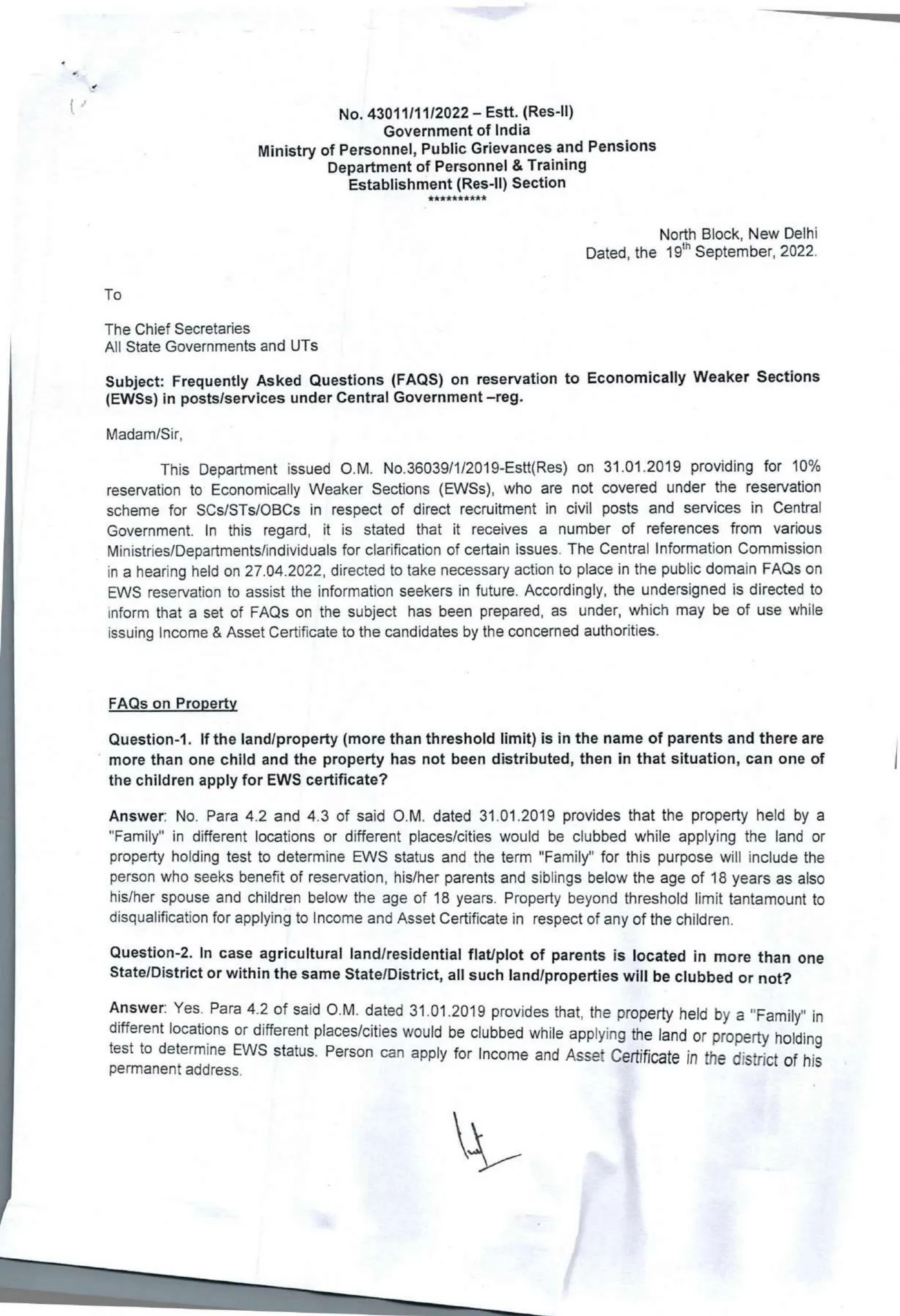
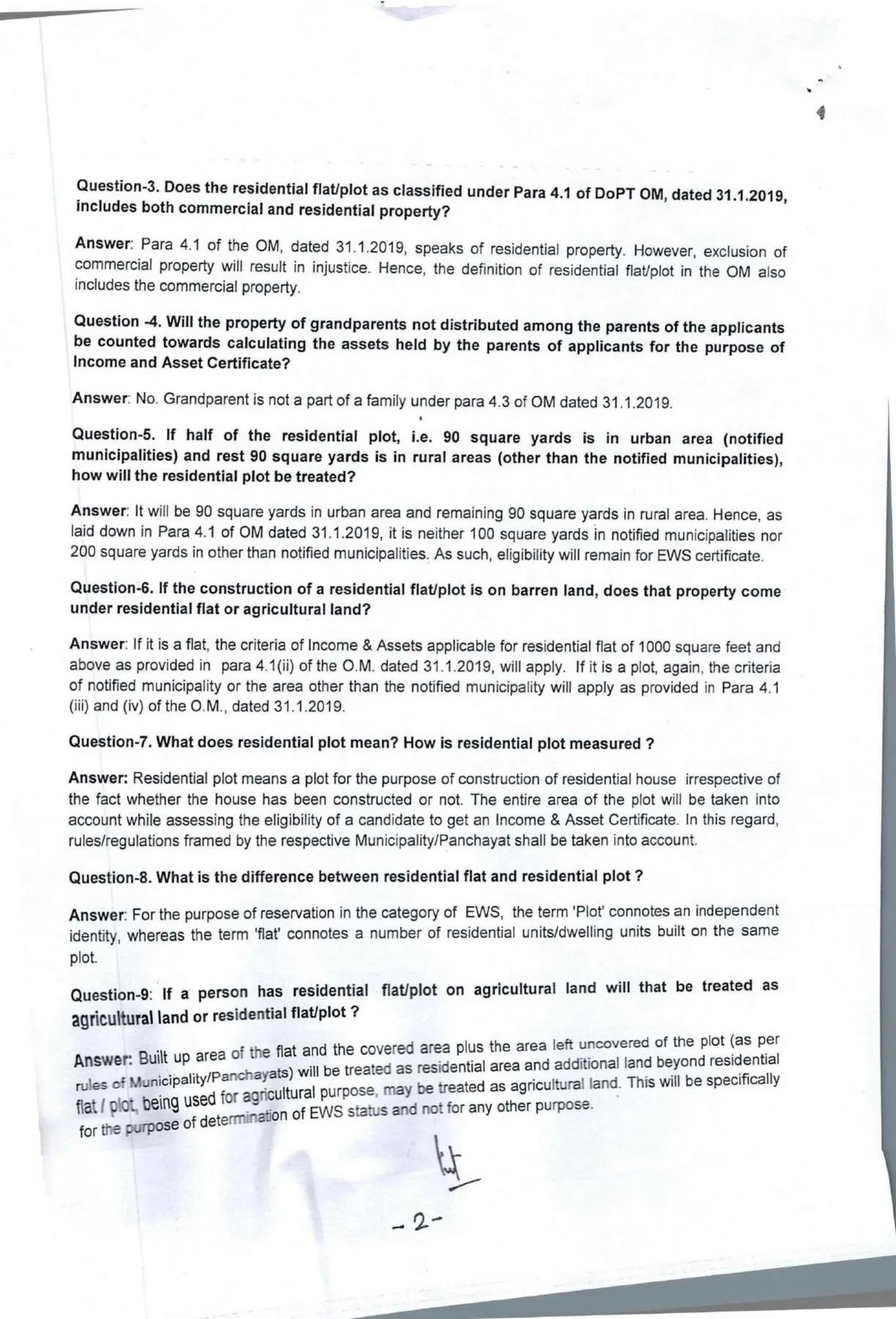
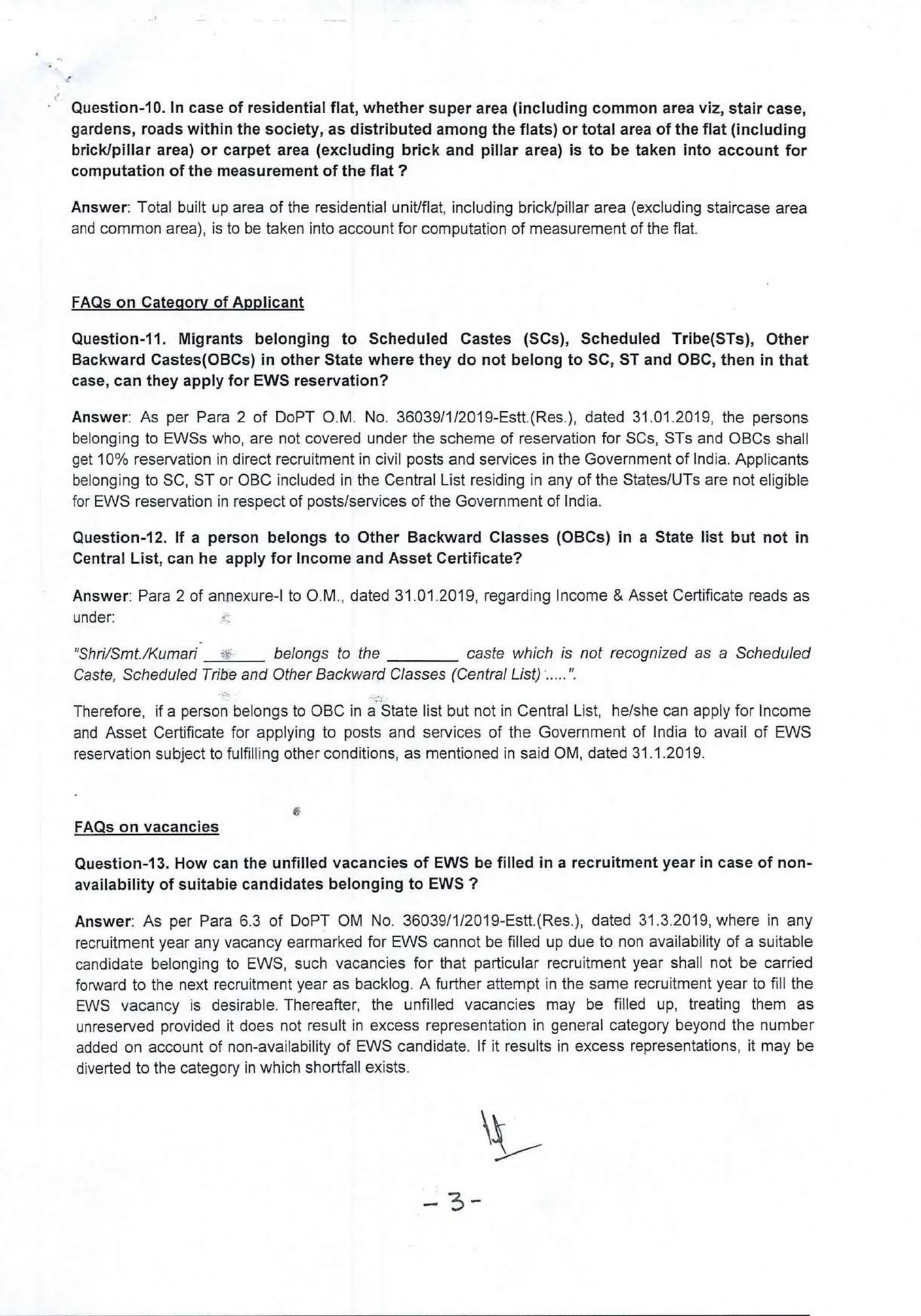
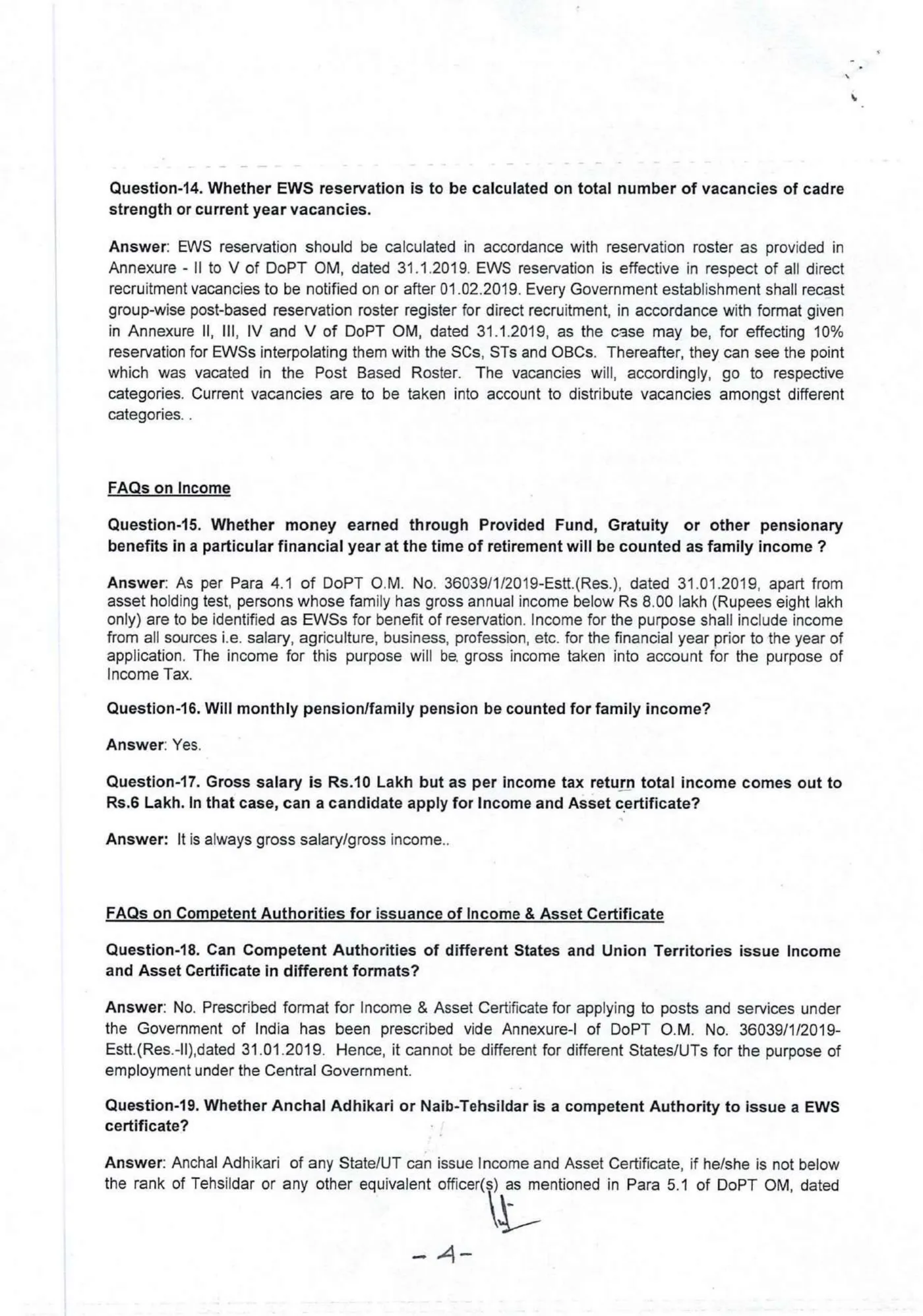
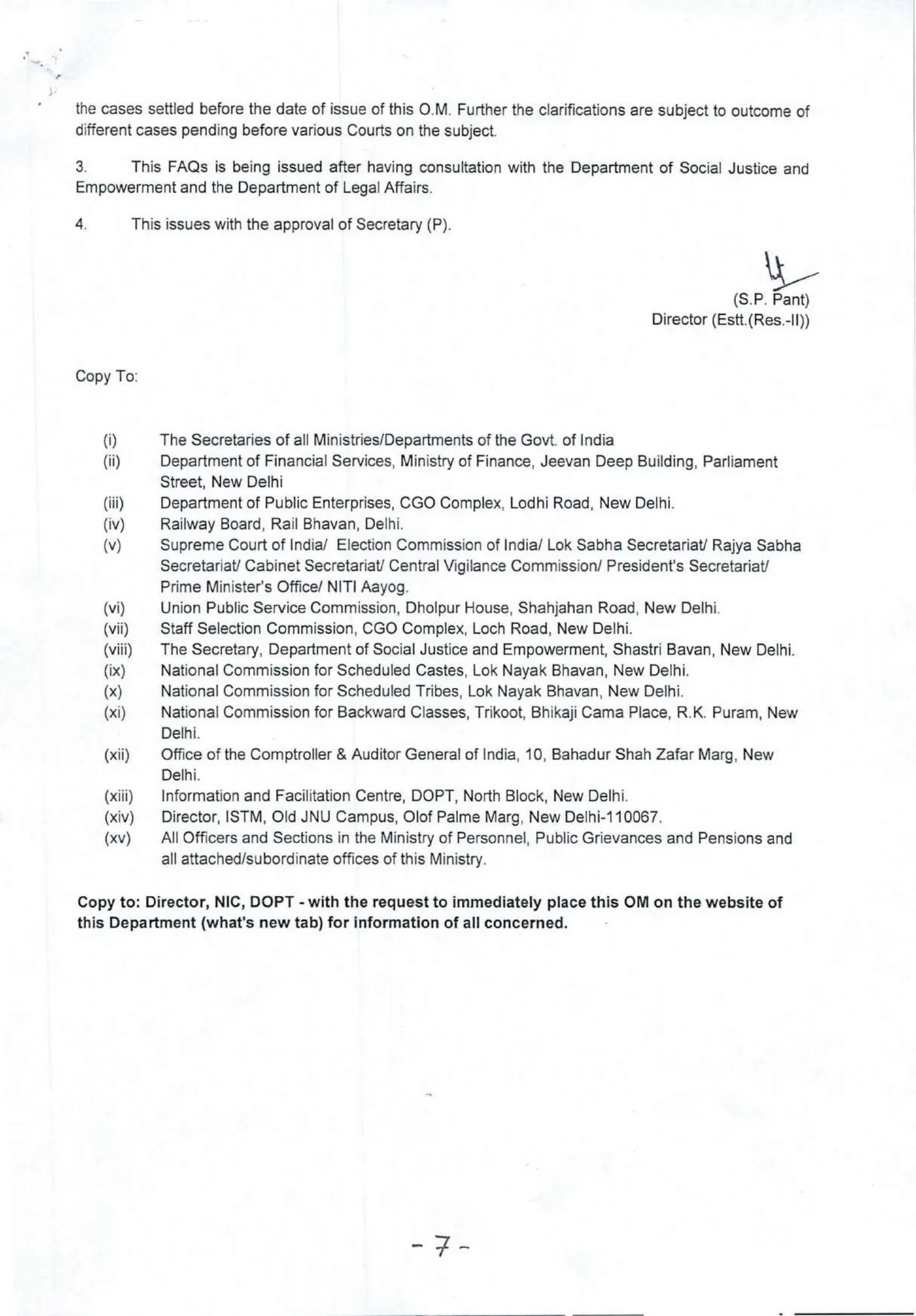
The 10% EWS share and the ₹8 lakh test come from DoPT’s EWS FAQs of 19 September 2022. The FAQs say EWS applies to direct recruitment vacancies notified on or after 01.02.2019.
Who counts as EWS
DoPT’s test has two parts. First, the family’s gross annual income must be below ₹8 lakh. Income covers all sources: salary, agriculture, business, profession and so on. Pension and family pension count. DoPT takes gross salary, so a lower taxable income in your ITR does not help.
Second, the family must not own any of these:
| Asset | Limit that disqualifies |
|---|---|
| Agricultural land | 5 acres and above |
| Residential flat | 1,000 sq ft and above |
| Residential plot in notified municipalities | 100 sq yards and above |
| Residential plot elsewhere | 200 sq yards and above |
All four limits are printed in the central EWS format, which CRPF reproduces as Annexure-H. The 5-acre land limit appears only there. DoPT’s FAQs repeat the flat and plot limits.
DoPT adds up the family’s property in different places and cities. Commercial property counts as a “residential flat/plot” too. For a flat, measure the total built-up area, including brick and pillar area but not staircases or common areas.
Who is “family”
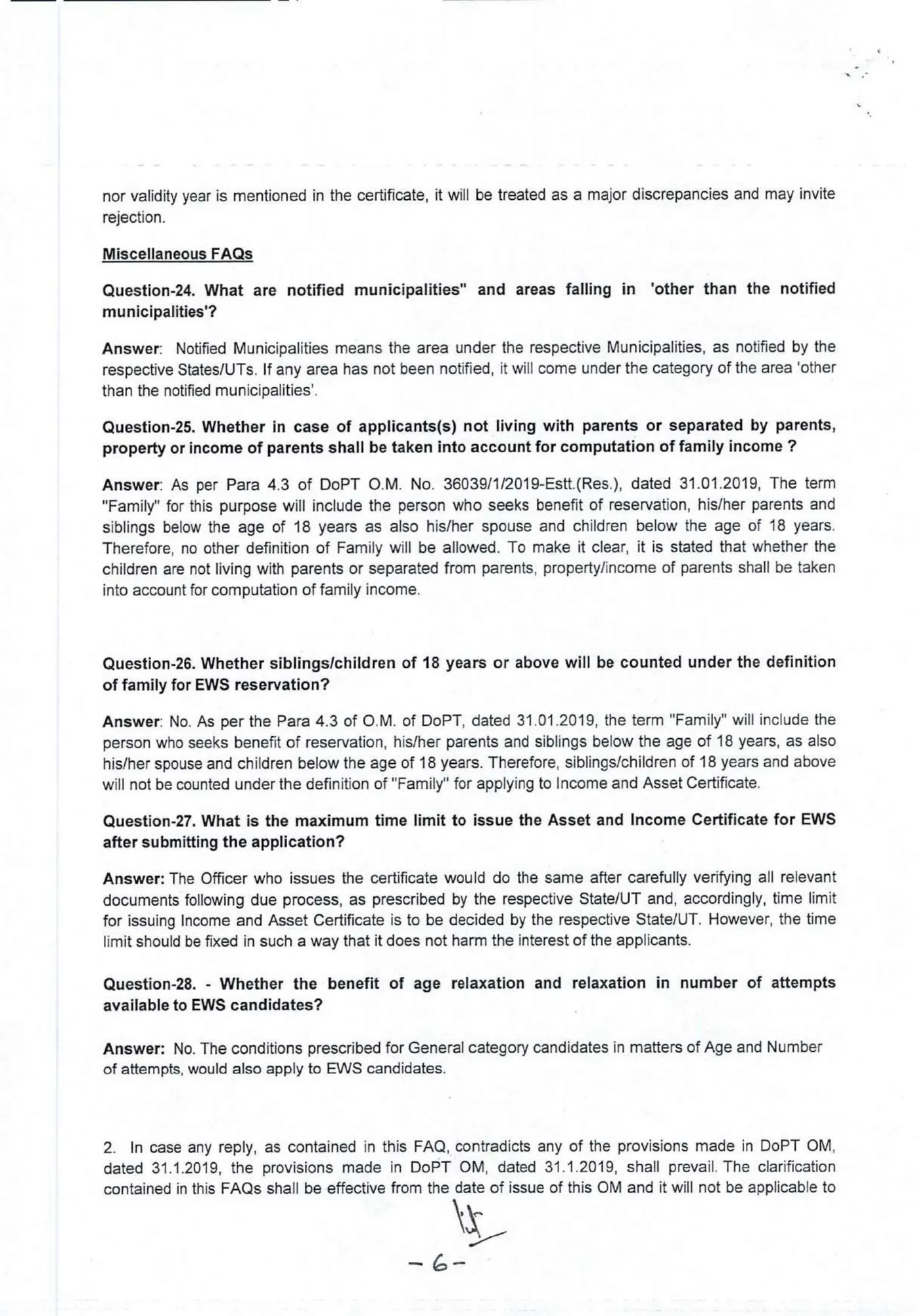
The family means you, your parents, your siblings below 18, your spouse and your children below 18. DoPT allows no other definition. Your parents’ income and property count even if you live apart from them. Brothers and sisters aged 18 or over are left out. So are grandparents, as long as their property has not passed to your parents.
Which year’s income, and how long it lasts
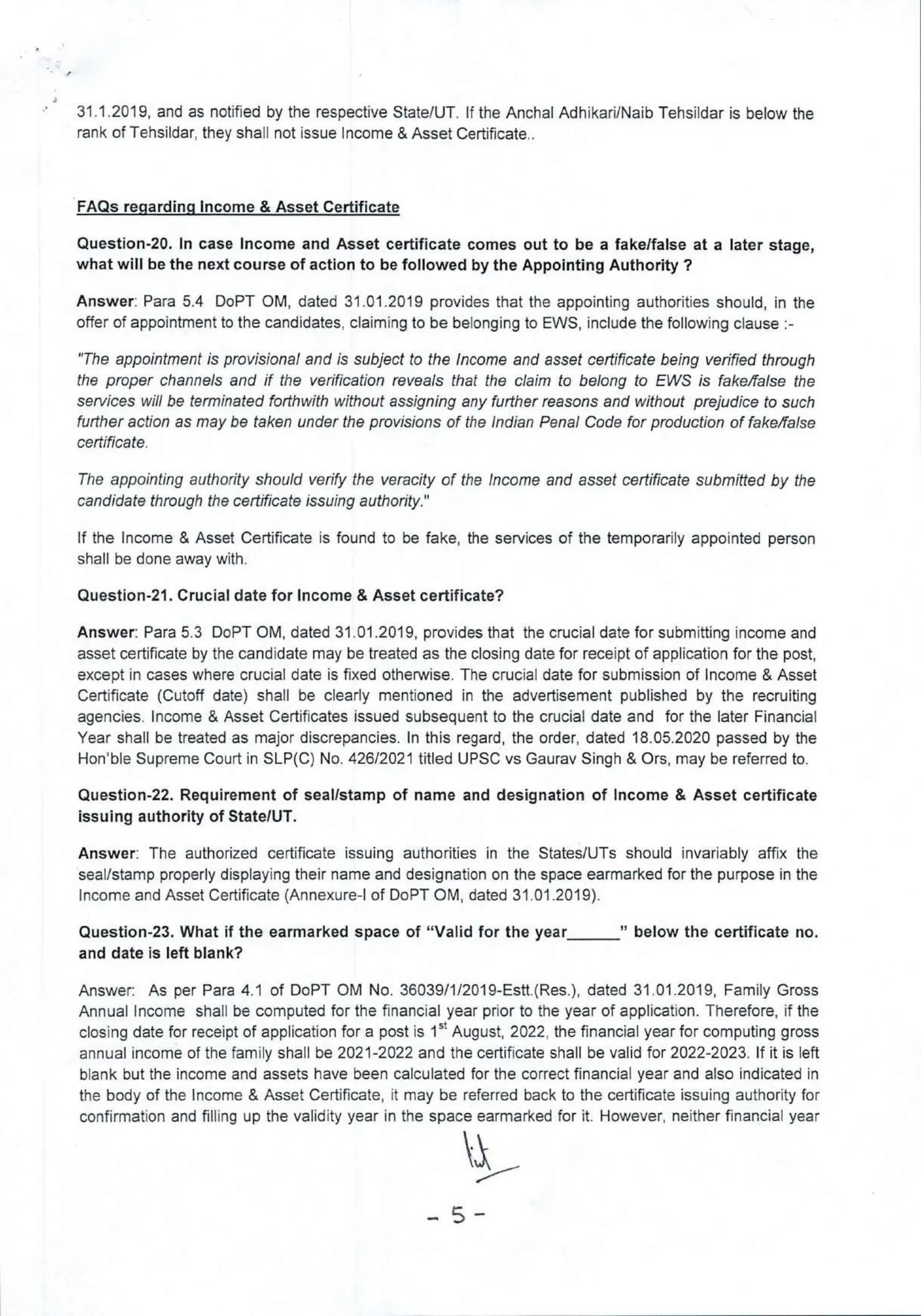
DoPT computes income for the financial year before the year of application. Its own example: for a closing date of 1 August 2022, income is for 2021-22. That certificate is valid for 2022-23.
| Last date to apply falls in | Income year on the certificate | “Valid for the year” |
|---|---|---|
| 2022-23 (DoPT’s example, 1 Aug 2022) | 2021-22 | 2022-23 |
| 2026-27 (SBI JA 2026 prints both years) | 2025-26 | 2026-27 |
CRPF’s 2026 notice asks for an EWS certificate “valid for the year 2026-2027”. It does not print the income year, but DoPT’s rule gives 2025-26.
The cut-off date for the certificate is the closing date of applications, unless the advertisement fixes another date. The advertisement must state this date clearly. DoPT treats a certificate issued after that date, or for a later financial year, as a major discrepancy.
Many applicants read validity as 12 months from issue. One asked on Careers360 in May 2026:
“my ews certificate issued on Oct 2025 is it valid for till oct2026?” (Careers360, 29 May 2026)
The FAQ does not use the issue date at all. It looks at the income year and the validity year. Say a notice closes on or after 1 April 2026. By DoPT’s rule, it needs 2025-26 income, valid for 2026-27. Always match the year your notice names.
Sometimes the “Valid for the year” box is blank but the income year in the body is correct. DoPT says the certificate may then go back to the issuing office to fill in the year. If neither year appears, DoPT calls it a major discrepancy that may invite rejection.
Who issues the EWS certificate
DoPT’s FAQ says you can apply in the district of your permanent address. The central format, as printed by CRPF, lists the authorities who can issue it:
- District Magistrate, Additional District Magistrate, Collector, Deputy Commissioner, Additional Deputy Commissioner or Deputy Collector
- 1st Class Stipendiary Magistrate, Sub-Divisional Magistrate, Extra-Assistant Commissioner, Taluka Magistrate or Executive Magistrate
- Chief Presidency Magistrate, Additional Chief Presidency Magistrate or Presidency Magistrate
- Revenue officers not below the rank of Tehsildar
- The Sub-Divisional Officer of the area where you or your family normally live
The FAQ covers the Anchal Adhikari too. He or she can sign only if not below Tehsildar rank and notified by the state or UT. An Anchal Adhikari or Naib Tehsildar below Tehsildar rank cannot. The officer must put a seal showing name and designation. Each state or UT sets its own time limit for issuing the certificate.
The central format
States cannot use their own EWS format for central jobs. DoPT prescribes Annexure-I of its OM of 31.01.2019. CRPF prints the EWS form as Annexure-H of its 2026 sports quota advertisement.
The form has a certificate number, a date and “Valid for the year”. It states the income for a named financial year and lists the four property limits. It certifies that your caste is not SC, ST or OBC (Central List), and it carries your attested photograph.
OBC-NCL: central list, state list, creamy layer
The central OBC form certifies three things. First, your community is a recognised backward class. The Ministry of Social Justice and Empowerment’s resolution says so. The officer fills in that resolution’s number and date.
Second, you and/or your family ordinarily reside in the named district or division. Third, you are not in the creamy layer listed in Column 3 of the Schedule to DoPT OM No. 36012/22/93-Estt.(SCT) of 8.9.1993, as amended from time to time.
The creamy layer rules sit in that Schedule and its amendments. Our official files do not print the current income figure. Check the OM in force or your notice. The District Magistrate, Deputy Commissioner or a similar officer signs, with a seal and date.
A state OBC certificate shows state-list status. For central posts, the caste must be on the central list. Now say your caste is on a state OBC list but not the central list. You can then claim EWS for central posts, subject to the income and property tests. A November 2025 question on Careers360 asked exactly this:
“i am having obc ncl state certificate. can i get ews CENTRAL certificate?” (Careers360, 6 Nov 2025)
One reply there says no. DoPT’s FAQ 12 says yes, if the caste is not on the central list. The other conditions still apply. Note that the income test covers one year: the financial year before the year of application. A flat disqualifies only at 1,000 sq ft or more.
What recent notices ask for
| Recruitment | OBC-NCL | EWS |
|---|---|---|
| SBI Junior Associate 2026 | Government of India format, “Non-Creamy Layer” clause, issued during 01.04.2026 to the date of taking up appointment | Government of India format, “for the financial year 2025-26 and valid for the year 2026-27” |
| CRPF sports quota 2026 | Appendix-F format, not in creamy layer on 11/11/2026, the closing date | Annexure-H, “valid for the year 2026-2027”, status date 11/11/2026 |
| UPPSC RO/ARO 2026 (state job) | UP’s own Appendix-1 format | Income of the year before the year of application, per UP’s OM of 18.02.2019 |
SBI also wants a declaration that you were not in the creamy layer on the last date of registration. It needs the EWS certificate at document verification, with no extension.
CRPF wants an OBC undertaking as Annexure-F and accepts no other format. UPPSC is a state recruitment, so it uses UP’s rules, and only UP residents get the benefit.
Common mistakes
- Using a state-format certificate for a central post. DoPT says the EWS format cannot differ between states for central jobs.
- Wrong year. A 2024-25 income certificate does not fit a notice asking for 2025-26 income.
- Wrong date. An SBI OBC-NCL certificate issued before 1 April 2026 does not meet its notice.
- A certificate issued after the cut-off date. DoPT calls that a major discrepancy.
- Signed by someone not on the list, such as a Naib Tehsildar below Tehsildar rank. Or no seal showing name and designation.
- Leaving out a parent’s income because you live separately, or adding an adult sibling’s income.
- Assuming EWS gives extra age or attempts. It gives neither.
If a recruiter later finds a fake EWS certificate, DoPT’s FAQ says the services end at once. Action under the Indian Penal Code may follow.
This guide summarises DoPT’s FAQs, the central formats and the notices above. It is not legal advice. Your notice and the issuing office decide each case. For other document checklists, browse our guides for government job applicants.
Frequently asked questions
What is the income limit for an EWS certificate for central jobs?
The family's gross annual income must be below ₹8 lakh. It covers all sources, including salary, agriculture, business and profession, and pension counts too.
Which year's income goes on the EWS certificate?
The financial year before the year of application. DoPT's example: for a closing date of 1 August 2022, income is for 2021-22 and the certificate is valid for 2022-23.
Is an EWS certificate valid for one year from the date of issue?
DoPT's FAQ links validity to the financial year, not to the issue date. It does not mention 12 months from issue. The certificate has a 'Valid for the year' box, and notices such as SBI JA and CRPF 2026 name the year they want.
Who can issue an EWS certificate?
The central format lists the authorities. They include the District Magistrate, Collector, SDM, Executive Magistrate and revenue officers not below the rank of Tehsildar. DoPT's FAQ says a Naib Tehsildar below Tehsildar rank cannot issue it.
Can a state-list OBC candidate get an EWS certificate for central jobs?
Yes, if the caste is on the state OBC list but not the central OBC list. DoPT's FAQ allows it, subject to the income and property tests. Castes on the central OBC list cannot claim EWS for central posts.
Does EWS give age relaxation in central jobs?
No. DoPT says the age limits and number of attempts for General candidates also apply to EWS candidates.
Official sources
- DoPT letter No. 43011/11/2022-Estt.(Res-II): FAQs on reservation to EWS in central government posts, 19 September 2022 (PDF)
- DoPT: Form of certificate to be produced by Other Backward Classes applying for posts under the Government of India (PDF)
- DoPT FAQs on the policy of reservation to SCs, STs and OBCs (PDF)
- SSC: OBC certificate format (PDF)
- CRPF advertisement R.II-21/2026-Sports, 17 September 2026, Annexure H (EWS format) (PDF)
- SBI advertisement CRPD/CR/2026-27/17: Junior Associates, 11 August 2026 (PDF)
- UPPSC advertisement A-4/E-1/2026: RO/ARO examination 2026 (PDF)
Every fact on this page was checked against the official notification. Always confirm on the official site before paying any fee.